Featured

Revolutionizing Value Creation for Mid-Market Companies

Agent prompt definitions for each module

Our thesis is simple:
Private companies in the $5M–$150M sales range are dramatically underserved by institutional tooling and strategy capacity, yet represent the most fragmented value-creation opportunity in U.S. markets. Owners and investors know the drivers of value — they lack the infrastructure to surface them quickly, debate them rigorously, and operationalize them systematically for TEV lift and exit outcomes.

MidMarket.ai  closes that gap by embedding AI agents directly into the decision loop alongside curated human experts (Certified Value Growth Advisors, exit-proven operators, and investor pattern-recognizers), creating a hybrid system that acts like a  shared strategic brain  for every engagement.

Featured

Checkout our Mission and Notebooks

Our mission is to connect the brightest minds in private business—owners, investors, and expert advisors—through a decentralized knowledge hub transforming how companies learn, grow, and build value. By combining curated expertise with AI-powered analysis, we give leaders the clarity and confidence to make high-impact decisions at every stage of the business lifecycle. https://notebooklm.google.com/

Featured

Our Shared Private Business Brain

MidMarket.ai is building a specialized search platform (shared brain) that utilizes natural language processing providing aggregated insights for private business from peer-reviewed, expert sources.

In today’s data-driven business landscape, the integration of Large Language Models (LLMs) into all business systems represents a significant shift toward more efficient and informed decision-making. LLMs, powered by advanced AI search technologies, are transforming how middle-market companies access and utilize data and information for optimum decision-making.

We’re a curated network of private owners, investors, and advisors sharing all the best learning and performance solutions to maximize business market value.

Learn more at: mnall@midmarket.ai !

See more here: https://www.perplexity.ai/search/summarize-u2PLiIllTBug2pbmqMwC_g

Featured

Our new ecosystem platform

The technology for our new ecosystem platform features a collaborative, open-source knowledge repository. Natural language artificial Intelligence search algorithms identify, organize, and feature highly relevant content while also and rating and ranking the participating experts. Enterprise search tools powered by machine learning and conversational intelligence, gather unstructured data from across the web pulling out the relevant facts for the best business decisions.  Meanwhile, consensus mechanisms rate and reward the best contributing experts.  

Next Steps:  

Identify a ‘brain trust” of like- minded individuals to hone the strategic vision and outline the initial process workflow of the platform. To accelerate our initial efforts, we are now recruiting a co-founding board of directors. In addition, we are seeking growth capital partners to further develop our technology platform, hire professional management, and create inbound marketing, publishing, and other organizational support services.  

To learn more about this business expansion opportunity, contact:    

Michael R. Nall mnall@midmarketplace.com  

312.636.9105 

Featured

Thinking About Relationship and Network Management — Ecosystems 4 innovators

By looking outside we open up. More and more demands are being placed on us via our customers, suppliers, our regulators and a host of other stakeholders all wanting to contribute into our existing knowledge. The ability to collaborate, to cooperate is coming by purposefully designing ecosystems and platforms We struggle to adapt to these […]

Thinking About Relationship and Network Management — Ecosystems 4 innovators
Featured

Connecting future value will come from Ecosystem thinking — Ecosystems 4 innovators

Ecosystems can offer so much connecting value out there to ‘form’ around. The value of breaking down long-standing boundaries is occurring with or without you. Barriers are dissolving as more recognize the need and value of coalescing around a networked ecosystem. The chances for greater, more radical innovation to grow the business comes from exploring […]

Connecting future value will come from Ecosystem thinking — Ecosystems 4 innovators
Featured

Our Experience

We are building the world’s 1st center of excellence for the private company marketplace. We are a peer-to-peer community of carefully selected private business owners, investors, and independent advisors. Freely sharing access to capital sources, knowledge, and best practices, we collaboratively design and implement optimum business outcomes. 

Why Us?

 Our cloud-based exchange platform features learning and performance solutions to buy, build, and sell private companies for the most value   When it comes to selection, we’re very choosy. We want to give business professionals the time and guidance you deserve.  

MidMarket Supermind

MidMarket.ai | Private Business Decision Intelligence

“MidMarket.ai enables a business-value Supermind, connecting owners, advisors, operating data, and specialized AI agents into a continuous system for creating transferable enterprise value.”

What are “Superminds”?

A Supermind is the paper’s term, drawing explicitly on Thomas Malone’s work at MIT, for an AI-augmented collective-intelligence system. The core idea is that intelligence does not have to reside in one person—or even in one machine. It can emerge from a network of people and AI-powered machines that collectively sense, remember, create, decide, act, and learn.

That makes “Supermind” fundamentally an organizational/network design concept, not simply another name for a more capable AI model. The paper imagines networks in which humans and machines connect, exchange knowledge, collaborate, and contribute different capabilities. AI can help those nodes discover one another, curate knowledge, and perform computational work.

Why Mid-Market Companies Need a CVGA Value Architecture Before They Need AI

Why MidMarket.ai Exists 

Michael R. Nall has spent more than forty years inside the middle marketplace, serving thousands of privately held companies with sales ranging from $5M to $500M. Over those decades, he saw the same painful truth repeat itself: Most private companies are just too small — too small to transform the owner’s personal wealth, too small to attract capital for transformative growth, too small to draw high‑quality buyers with sufficient funding. 

He watched owners make the biggest financial decisions of their lives with less guidance than someone buying a house. He watched fragmented advice, siloed expertise, and fragile institutional memory erode enterprise value. And he watched the advisory profession — one he helped shape through the creation of the Certified Merger & Acquisition Advisor credential — struggle to scale its impact. 

Michael understood something fundamental: Privatemarket knowledge is valuable but fragile — trapped in conversations, diligence notes, playbooks, and tacit judgment. 

And he knew the consequences: Businesses routinely sold for 30–50% less than their potential value because they were not market‑ready and lacked structured value‑growth processes. 

The Turning Point 

Then came the rise of large language models and AI‑driven search. For the first time in history, even smaller companies could computationally analyze collective knowledge and accelerate innovation. As your document states: 

“We are at a unique point in history where even smaller companies computationally analyze our collective knowledge and accelerate the process of innovation.” 

But generic AI wasn’t enough. It produced content, not judgment. It answered questions, not decisions. It lacked the contextual discipline required for high‑stakes value creation. 

Michael saw an opportunity to build something different — something humanfirst

The Vision 

MidMarket.ai was born from a simple but profound thesis: 

The future of middlemarket advisory is a humanagent system built on valuebased management, shared intelligence platforms, and measurable Total Enterprise Value outcomes. 

Instead of replacing advisors, MidMarket.ai would complete them — giving every advisor a Second Mind, Second Memory, and Second Set of Hands. 

Instead of scattering knowledge across thousands of conversations, it would protect, organize, and amplify it through a Shared Brain and Context Engine

Instead of episodic advisory, it would create structured, longitudinal value‑creation programs powered by TEV diagnostics, agentic workflows, and collective intelligence. 

The Build 

Michael assembled a founding Brain Trust — systems thinkers, pattern recognizers, generous collaborators, and mission‑driven advisors — to co‑create the platform’s architecture, go‑to‑market strategy, and pilot launch. 

Together, they designed: 

  • The Shared Brain: a specialized search and knowledge system using NLP and multi‑agent AI. 
  • The Context Engine: a memory architecture that turns fragmented intelligence into actionable decision support. 
  • The Enterprise Value Map & TEV Engine: a structural map of constraints, levers, and value pathways. 
  • The Diagnose → Prioritize → Activate → Measure workflow that operationalizes value creation. 

MidMarket.ai isn’t a tool — it’s a category: AIamplified private business value creation. 

The Purpose 

At its core, MidMarket.ai is a philosophical project as much as a technical one. 

Your documents say it clearly: 

“Technology is the expanding surface area of stable human desires — clarity, meaning, connection, capability, optionality.” 

AI should not replace humans, but complete them — preserving knowledge, enhancing reasoning, accelerating decisions, strengthening relationships, and unlocking potential. 

MidMarket.ai is the first platform built explicitly on this humanfirst futurism in the middle market. mnall@midmarket.ai

One Big Idea

MidMarket.ai thought‑leadership themes center on one big idea: the middle market is entering a new era where AI‑augmented advisors, value‑based management, and shared‑intelligence platforms become the core infrastructure for private‑company growth, valuation, and transfer readiness.

Digital Advocates

Q: Increasing Private Business Market Value
A: Your insights corpus is rich on this topic. Here’s how the Digital Advocacy document connects to your core framework for Increasing Private Business Market Value:


The Bridge: Digital Advocates as Value MAXIMIZERS

Your MidMarket.ai document positions Digital Advocates as a new layer of intelligence for the middle market. This maps directly onto the value creation framework you’ve built over 40+ years:

1. Solving the #1 Value Killer: Owner Dependency

Your own research identifies owner dependency as the primary de-valuation factor for private businesses. Digital Advocates directly address this by:

  • Preserving judgment — converting the owner’s tacit knowledge into persistent business memory
  • Codifying decision-making — replacing “head knowledge” with documented, AI-augmented systems
  • Enabling the business to function independently of the founder, which is exactly what drives higher exit multiples

2. Closing the Infrastructure Gap

You’ve documented that 200,000+ U.S. companies ($10M–$1B revenue) lack the decision-making infrastructure Fortune 500 firms take for granted. Digital Advocates provide:

  • A Private Company Decision OS — not a chatbot, but a system that understands private company value mechanics
  • Continuous intelligence that compounds with every decision
  • The institutional quality that commands premium multiples

3. Accelerating the VBM Framework

Your Value-Based Management approach requires shifting from short-term, tax-driven thinking to long-term value creation. Digital Advocates operationalize this by:

  • Tracking Transferable Enterprise Value (TEV) systematically
  • Matching specific constraints to proven strategic plays via the Value Opportunity Profile (VOP)
  • Connecting those plays to the right expert advisors and measuring impact

4. Powering the Ecosystem

Your philosophy — that collaborative ecosystems of owners, investors, and advisors accelerate growth — is the engine behind the Digital Advocate model:

  • Advisors, operators, and builders co-create the system
  • The shared intelligence layer compounds across the community
  • AI amplifies human expertise rather than replacing it

The Pitch in One Line

Digital Advocates turn your proven value creation methodology — VBM, VOP, risk reduction, owner independence — into a persistent, AI-powered system that works 24/7 for every private business in the middle market.


Want me to draft specific messaging that connects this Digital Advocacy concept to particular audiences (advisors vs. owners vs. investors)? Or would you like me to find experts on SuperMe who could sharpen the positioning?

AI advantages of being smaller:

A fundamental shift is underway in the business landscape, with 2026 marking an inflection point where mid-market companies are deploying advanced AI capabilities faster than large enterprises. This inverts the historical pattern where emerging technologies typically mature in large, well-funded corporations before trickling down.

Mid-market companies are outpacing larger competitors due to several key structural advantages:

  • Freedom from Legacy Infrastructure: Large enterprises are often constrained by decades of technical debt, relying on aging on-premise ERP systems, multi-generational data warehouses, and highly complex integrations. Upgrading these systems requires multi-year cloud migrations and massive capital. Conversely, many mid-market organizations still rely on simpler tools like Excel or departmental applications. This lack of complex infrastructure provides the strategic flexibility to quickly implement cloud-native AI solutions without navigating massive sunk costs or system-wide disruptions.
  • Decision-Making Velocity: Large corporations are burdened by extended governance cycles, extensive architecture reviews, and multi-layered management approvals. By the time an enterprise secures authorization for an AI project, the technology and market conditions have often already changed. Mid-market companies benefit from smaller leadership teams and concentrated decision-making authority, allowing them to approve and launch pilot programs in weeks rather than quarters.
  • Organizational Agility: In mid-market firms, executive leadership can drive organizational change directly. This allows them to bypass the resistance to change that typically cascades through the thick middle-management layers of larger enterprises.
  • Focused, Practical Deployments: Rather than attempting comprehensive, company-wide technological transformations, mid-market companies are succeeding by focusing on specific, high-impact AI applications that integrate directly into their existing systems. They are rapidly deploying AI for immediate returns in areas like pricing optimization, supply chain predictive analytics, working capital optimization, and customer retention.

Ultimately, the traditional enterprise advantages of abundant capital and massive technical resources are becoming less pivotal than the mid-market’s agility, speed, and ability to execute highly focused AI solutions.

The Current Bottleneck: Semantic Isolation

Despite their individual brilliance, today’s agents suffer from semantic isolation. They typically operate alone or in small, siloed teams, which limits their potential. If a sales agent figures out how to handle a complex pricing negotiation, that insight stays isolated; a forecasting agent in the same company cannot leverage that breakthrough and must start from scratch. Up to this point, the AI industry has primarily scaled individual agents vertically (creating “individual geniuses”), but these agents cannot yet “think” together collectively

VCII Public Library and Hub – NotebookLM

The Advisory Gap

The advisory gap is real, and it’s worse than most people think. These 350,000+ businesses between $5M and $100M in revenue represent roughly one-third of U.S. GDP. Yet the typical owner in this segment makes the biggest financial decision of their life, selling their company, with less professional guidance than someone buying a house. I saw this for 40 years. Owners getting fragmented advice from specialists who only see one piece of the puzzle. A tax CPA who doesn’t understand deal structure. An attorney who’s never run a process. A broker who can’t speak the language of private equity. The result: businesses sold for 30-50% less than they should have been.

The Problem We Care About: Middle‑Market Knowledge Is Disappearing

Every private company is built on a lifetime of:

  • owner decisions
  • tribal knowledge
  • undocumented processes
  • pattern‑recognition
  • lessons learned the hard way
  • advisor insights that never get captured
  • institutional memory that lives in people, not systems

And 99% of that knowledge vanishes when:

  • an owner retires
  • a key operator leaves
  • an advisor engagement ends
  • a crisis forces reactive decision‑making
  • a company transitions to the next generation

This is not just inefficiency.
It is value destruction at scale.

The lower middle market loses billions in enterprise value every year because the knowledge that creates value is never preserved, structured, or made reusable.

Certified Value Growth Advisor Course

Supermind for Private Business Market Value

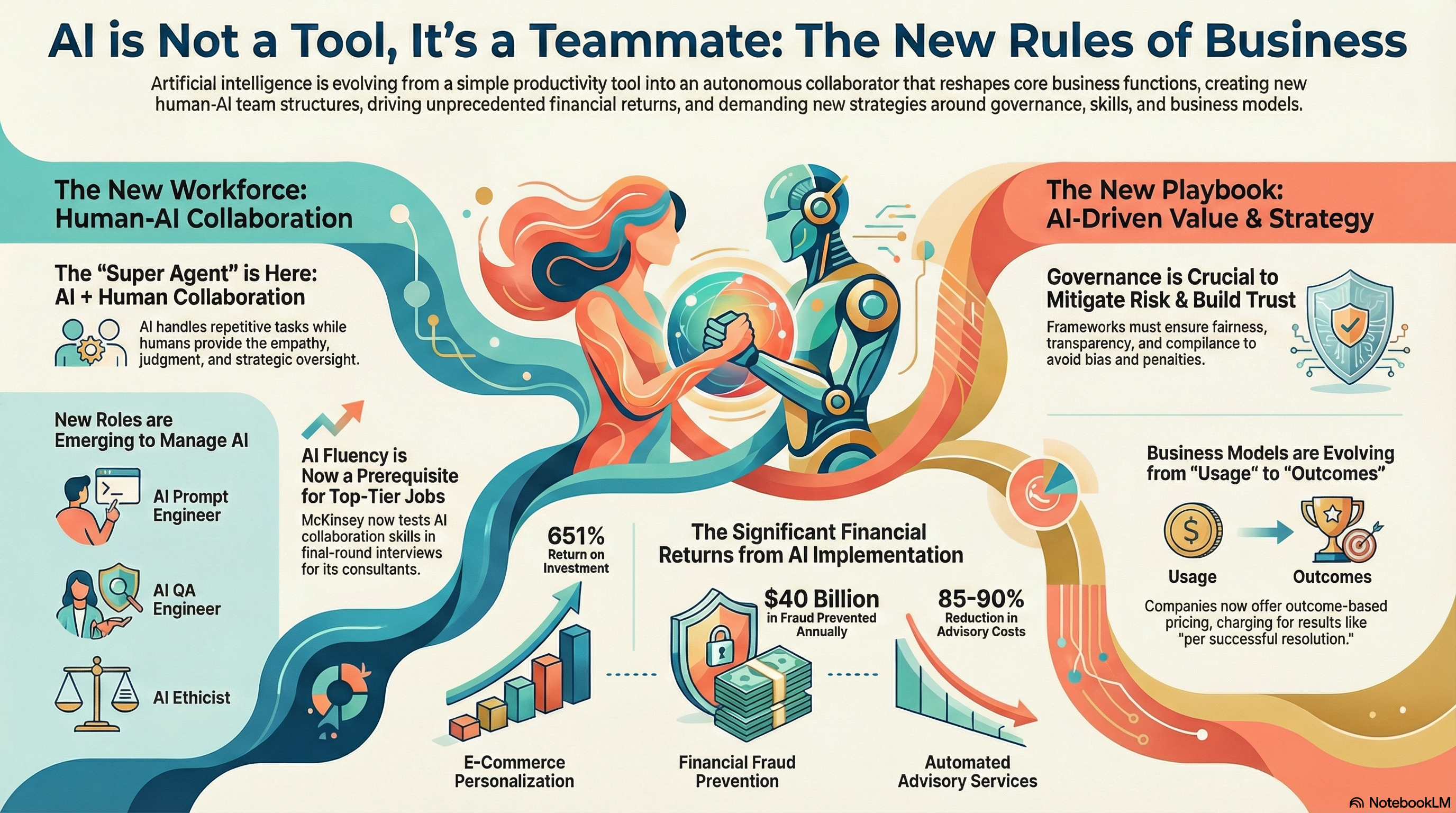
The document argues that the real competitive advantage in 2026 is not AI alone, but the deliberate design of cognitive partnerships between humans and AI. As AI evolves from assistive tools to autonomous, agentic systems, organizations must shift from automation-first thinking to human-led, AI-operated decision architectures.

Core thesis:
AI excels at intelligence (pattern recognition, computation), but wisdom—context, judgment, ethics, and timing—remains uniquely human. The highest-performing enterprises deliberately architect systems where AI amplifies human judgment rather than replaces it.

Key ideas and implications

  • From automation to augmentation
    AI should reduce cognitive load and surface insights, while humans retain ownership of high-stakes decisions such as strategy, M&A, and advisory judgments.
  • The cognitive load paradox
    While AI reduces short-term mental effort, over-reliance can degrade attention and confidence. The solution is structured decision workflows that limit noise and prioritize decision-relevant outputs.
  • Human wisdom as the bottleneck—and advantage
    Research shows AI lacks qualities like intellectual humility, perspective-seeking, and ethical integration. Experienced operators and advisors provide the contextual judgment AI cannot replicate.
  • Generative Collective Intelligence (GCI)
    Drawing on MIT and Stanford research, the document emphasizes group-level human–AI collaboration. AI acts as a facilitator that aggregates, ranks, and connects human insights while reducing bias and groupthink.
  • AI clones and digital twins
    Personalized AI models trained on an expert’s frameworks and reasoning can scale scarce advisory talent. These “AI clones” preserve attention while extending expertise across many clients or teams.
  • The agentic enterprise (2026 inflection point)
    Enterprises are moving from copilots to autonomous multi-agent systems that plan and execute workflows. However, many efforts fail without governance, clear ROI linkage, and human override mechanisms.
  • Decision architecture for high-stakes environments
    Maximum AI value depends on three human decisions: choosing the right question, trusting (or not trusting) the answer, and owning execution. Explainability, confidence calibration, and transparency are essential.
  • Governance as a competitive moat
    Responsible AI—clear permissions, auditability, and human accountability—is framed not as compliance overhead but as a trust and scale advantage.

Overall conclusion

The document proposes a seven-principle cognitive partnership architecture (human-led, structured questions, expert clones, collective reasoning, compounding knowledge, calibrated confidence, and governance). The end state is not AI replacing advisors or leaders, but AI making every human decision-maker more capable by embedding collective wisdom into scalable, governed systems.

/https://acrobat.adobe.com/id/urn:aaid:sc:US:a4b20ea7-9098-4e80-892c-e6ecadd5b2a6

Closing the Value Gap

There are 200,000+ U.S. companies generating between $10M and $1B in revenue — the backbone of the private economy — with no access to the decision-making infrastructure that their Fortune 500 counterparts take for granted. That’s the market MidMarket.ai was built to serve.

I’m Mike Nall, founder of the Alliance of M&A Advisors (AM&AA) and CEO of MidMarket.ai. After 40 years advising in the lower middle market, I’ve seen the same constraint repeat across hundreds of deals: owners trapped working in their businesses rather than on them, exit multiples discounted by owner dependency, and EBITDA left on the table — not for lack of opportunity, but for lack of infrastructure.

MidMarket.ai is the platform that closes that gap.

We’re building a hybrid-intelligence Private Company Decision OS — not a chatbot, not a generic AI assistant, but a purpose-built platform that:

  • Understands the mechanics of private company value
  • Matches problems to proven strategic plays
  • Matches plays to the right expert advisors
  • Tracks every recommendation’s impact on Total Enterprise Value (TEV)